

Most people reading this know me from my YouTube channel (@mattlarsen1000x), where I talk about different ways to grow agencies. If you don't, my name is Matthew Larsen:
Most agencies run into the same four problems:
The purpose of this Skool group is to solve all four problems, once and for all. I will explain how that happens throughout this page, and the system we will build to do it.
Throughout this page, I am going to refer to agencies a lot, because that is where I have the most experience. But whenever I say agencies, you could just as easily substitute any online service-based business and everything would apply just the same.
I have been running agencies for the better part of the last 12 years, including three agency exits (all in ecommerce). One was in 2017, one was in 2019 (same team as the one in 2017) and one was in 2023.
I know agencies better than most. Agencies, much like any service-based business, have their flaws in terms of the business model. Simply put, there are a lot of things that SUCK about them.
Let’s spike your cortisol a little by naming a few of the high-level things that absolutely suck:
And overall, just constantly feeling like you are wasting your life.
But, we are not done. Just to be cruel, let’s see if we can visualize a few of the worst things we can experience day-to-day:
Okay, that was mean. I will stop this now.
Inherently, we always know the “grass is always greener” and all business models have their bullshit but my god, it just feels like you are in an uphill battle no matter what.
Anyways, it’s not ALL bad. Agencies have their benefits too.
There are many good things about them that we can forget when we are in the trenches getting overloaded by all the bad things.
What are some good things?
These things are genuinely good. Really good.
So naturally, this leads to a very interesting question:
What if we could still keep all the good parts of running an agency while getting rid of (or at the very least, severely limiting) all of the traditional negatives?
So how do we keep the good and get rid of the bad? That is what the rest of this page is about.
Lead Generation Academy is not a biz-op, nor is it for beginners or you making a different agency than the current one.
It is just you adding an education arm to your already existing agency.
It is for people already running agencies who want to get to the next level but are not sure how.
In some ways, it is a “new way” to run an agency, but in other ways, it is completely logical, and people have been doing it for a long time.
The entire purpose of this Skool is to help you build this new way of doing things, step-by-step-by-step-by-step so that you can transform your business and ultimately your life.
We will be building a hybrid service and education business (instead of just service) and then have an entire offer and marketing ecosystem around it.
No longer will you solely have to rely on a very transactional dynamic of X service for Y price.
There are two problems with this:
Turning our pure service-based business (such as an agency) into a hybrid service-education business solves both of these problems.
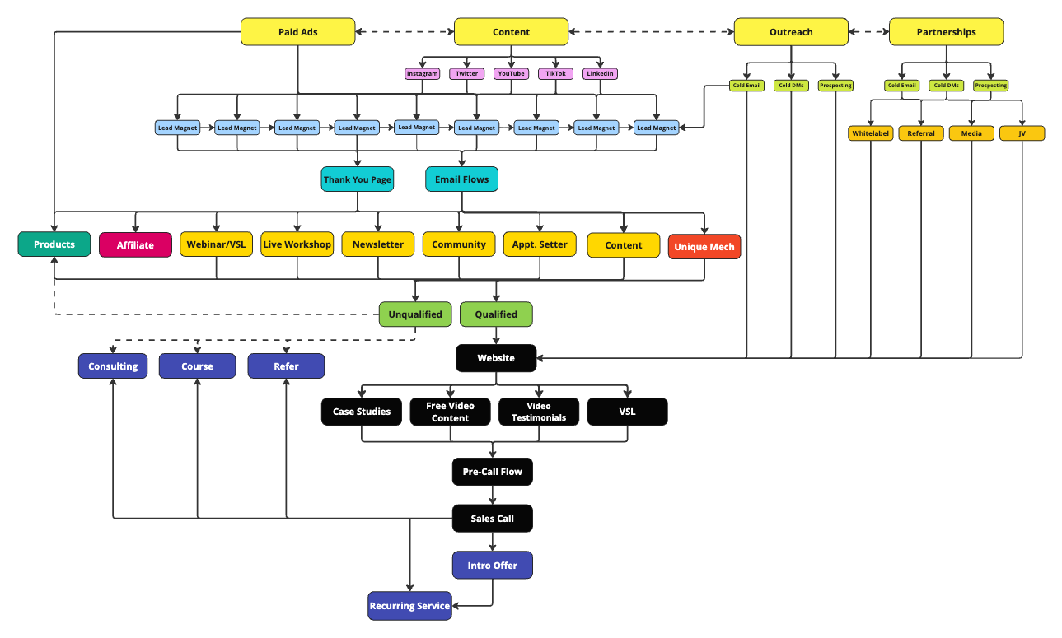
When we transition from a pure service-based business into this hybrid business, we start to form an ecosystem around our business. People can find out about us through different channels such as paid ads, content, outreach, partnerships and so on.
Then, they can be moved down our funnel and can buy different products (whether it be service or education) based on where they are at and based on which delivery method they prefer (done-for-you, do it yourself, done-with-you, etc.)
Over time, we will learn that people who have bought our lower level education products will seek us out and become some of our best clients as they progress and grow their business and eventually become qualified.
A lot of that may sound good in theory, but practically speaking, what kind of system would we have to build to create an ecosystem such as this? It sounds a bit complicated, no?
Well, that is what we are here for. This is a diagram of exactly what this system will look like:
Take a look at it. Screenshot it. Zoom in. Try and understand how all of the pieces flow together.
This is the marketing and offer ecosystem we referred to earlier. This is how it all comes together to create what I would consider to be the absolute peak of an agency model in the service-education hybrid.
This system exists because of the four main problems that service businesses face:
The system solves all four. Let’s go through it from top to bottom.
At the very top, we have four ways to get attention: paid ads, content, outreach and partnerships.
It is very good to have multiple ways because then your business is not dependent on just one. That leads to a lot more safety and stability.
These four ways also make each other more effective. If someone has watched your content for a long time and then gets outreach from you, they are much more likely to respond. If someone sees your ad, clicks on your profile and sees a bunch of content, they are much more likely to book a call than if your profile was blank.
Paid ads and content send people to lead magnets. From there, they hit the thank you page and the email flows.
Then they get nurtured through things like the webinar or VSL, a live workshop, the newsletter, the community, appointment setters and even more content.
The whole job of the middle of the funnel is to figure out whether someone is qualified or not. Sometimes they self-qualify (they decide “this is for me” and book a call). Other times, we have information like their revenue level from a webinar signup, and we reach out to them.
Qualified leads go to the website, where they see case studies, free video content, video testimonials and the VSL. Outreach and partnerships usually skip straight to this part, because they start at the call phase. Those people don’t really click anything.
Then, the pre-call flow gets them to show up to the call pre-framed and educated, so the call itself is higher quality.
On the sales call, we can either sell them an intro offer that leads into the recurring service, or go straight to the main recurring service.
This is where most agencies fall apart. Most people only have their main recurring service. If a lead is not in the very small percentage of the market that is shopping for that service, qualified for that service and able to afford that service, that lead is completely wasted. For most agencies, that is 97, 98, 99% of their leads.
In this system, unqualified leads (and people who are not a fit on the sales call) still have somewhere to go. We can sell them products, our course or our consulting. No matter who comes into our funnel, we can monetize them in an efficient and good way.
That is how the system solves all four problems. More people know who you are, you have a predictable way to generate and convert leads, you are no longer reliant on referrals, and you can monetize every lead that comes in.
Now let's look at why this matters so much.
Here is the full system, and the four problems it solves.
That is the funnel side. But the system is only as good as the person running it, which brings us to you.
If it looks big, new and complicated, don’t worry. I walked through it piece by piece at the top of this page, and everything that follows builds on it.
But, is that true, or am I just saying this to get you to pay me?
Let’s go over how it removes a lot of the negatives. We will do so very simply, but it will be enough to clearly see how this reasonably could be true (from your POV).
Your education sales will help even out the highs and lows caused by service based revenue where clients come and churn and come and churn.
The hamster wheel exists because the only way to make more money in a service-only agency is to take on more clients. More clients means more work, more team members and more problems. Every dollar you make is tied to your time or your team's time.
With the education side, you are now making money from things you only have to build once. You record a course once and you can sell that course over and over again without having to fulfill anything new. So for the first time, working harder actually gets you somewhere, because the work you put in keeps paying you back.
Clients will still churn. That is part of running a service business, and nothing is going to fully fix that. But when a client leaves now, they do not have to leave your ecosystem.
The client who wants to take things "in-house" can buy your course or your consulting and learn to do it themselves. They were going to go in-house anyway. Now they go in-house with you, and you keep making money from them.
On top of that, your clients will be watching your content. Clients who watch your content are more bought in and much less likely to churn in the first place.
You will probably still have to do this, not going to lie about that. But, because you have so much more margin and revenue from adding the education side of things, you can more comfortably afford to pay your A Players more money, and over time, you will weed the idiots out of your business.
A pure service business is hard to scale because every new client needs more labor. Education products do not need more labor. They have 95%+ gross margins, and you can sell a course to 10 people or 10,000 people with basically the same amount of work.
Your agency does not have to become scalable on its own. The ecosystem you build around your agency is scalable, and that changes the entire business.
You will now be selling info-type products too such as courses and consulting, but you won’t need to go full guru and look like an idiot. This is what I do, and it is great. In addition to that, I am of the opinion that a lot of info products fail over time because the person stops running their main business (that the info product is about) and therefore, stop learning and their info becomes obsolete.
Because you have something to sell to everyone, you will now be more mentally willing to go harder on content than ever before. This will build a personal brand over time which will help you not be viewed as a commodity. In addition to that (and I use this one often), when people are shopping my agency against others, I tell them “yea, all the other agencies join my thing to learn how to do it. You can either go to a knockoff or work with the original.” Works well.
Most of your competitors are fighting over the same 1-5% of people who are actively looking for (and qualified to buy) a service right now. That is why everything feels so saturated. Everyone is selling the same thing to the same small group of people.
You will now be able to sell to the other 95-99% that everyone else ignores. On top of that, you will be building media leverage and a personal brand with your content. It is very hard for another agency to compete with you when the prospect has been watching your videos for six months and has never heard of the other guy.
Since you now have other revenue streams from courses, consulting and education, you will not need to take on every client who wants you. In fact, you now only need to work with the BEST possible clients.
When you build your course, you are basically writing down how you think and how you solve problems, step by step. That is the exact same material your team needs to be trained on. Your course doubles as your SOPs.
So instead of answering the same question for the 50th time, you send your team (and your clients) the module that answers the question. And because you have more margin, you can afford A Players who solve problems on their own instead of bringing every problem back to you.
Most agency owners spend their whole day on stuff that only pays them once: fulfillment, putting out fires, and back and forth on Slack. In this system, you time block four hours per day for high-leverage work. Two hours go to building your course, and two hours go to building the ecosystem and funnel.
Everything you build in those four hours keeps working for you after you are done. That is the difference between low-leverage and high-leverage work, and we will get into the four types of leverage shortly.
Teams make dumb mistakes for two main reasons. You hired the cheapest people you could afford, and they do not have a clear process to follow.
The hybrid model helps with both. More margin means you can afford to hire A Players. And the course you build becomes the step-by-step process your team follows, so there is a lot less guessing and a lot less babysitting.
In a normal agency, fulfillment and acquisition are a seesaw. When you are busy fulfilling, you stop doing acquisition. When you run out of clients, you panic and go back to acquisition. That seesaw is where feast and famine comes from.
In this system, a lot of your acquisition is built once and then runs on its own. The course you build gets repurposed into your content, your consulting and your trainings, and that content brings leads in while you sleep. Your paid ads, email flows and appointment setters keep the funnel moving even when you are buried in fulfillment.
That is how this new way of running an agency solves problems on a basic level, but the benefits don’t stop there. To show you what I mean, let’s look at one of the most important mental models there is, and apply it to what I am proposing.
There are at least five things that happen when you switch from a service-only agency to a hybrid service-education agency. Let’s look at each of them, along with their first-, second- and third-order effects.
This framework will show just how powerful this is in the short, medium AND long-term.
First, you now have something to offer everyone: your service, your consulting and your course. Because you can monetize viewers outside your ICP, you go harder on content than ever before. Because you have downsells, your ads are more profitable than ever. And because you are always making sales, you get constant dopamine hits that keep you going. Over time, going harder on content gives you a bigger network and better access to talent, and making more sales gives you more money to reinvest in ad spend and a content team.
Second, your blended margin goes up, because consulting, courses and similar products run at close to 95%+ margin. That extra margin means you can test more ads, reinvest in a full content team and afford to hire A Players. Because you have A Players, you stop being the bottleneck and get your time back. And because you tested more ads and built a content team, you generate even more leads and end up on the good side of The Infinite Cycle of Lead Generation.
Third, because you have other revenue streams, you can say no to everyone except the best-fit clients for your agency. Your clients get better results, because you only work with people you know you can help. You have fewer nightmare clients eating up your time and capacity, and your team is less stressed and makes fewer mistakes. Better results lead to better case studies and more referrals, which means more leads. And you become known as the agency that only works with the best, which lets you raise your prices.
Fourth, you end up with a much larger number of total clients and fans. More people are watching your content, buying your products and talking about you, so you get more referrals and more word of mouth. Over time, you end up “owning” a keyword in the mind of your market, you build a network and access to talent that most agency owners never get, and your business becomes much harder to compete with and much more valuable if you ever sell it.
Fifth, you can sell to people long before they are qualified for your service. The people who buy your lower-level products learn from you and grow their business, and you build trust with them long before they ever get on a sales call. Eventually, those education buyers grow into some of your best service clients. They come in already bought in, so they are easier to close and easier to keep, and your business starts growing its own future clients instead of relying on referrals.
Notice that every one of those chains ends in the same place: more leads, more margin and more time. That is not an accident. It all comes down to one word.
I am very passionate about generating leads.
From the time I was 3 years old, I knew that all I wanted to do when I grew older was to generate qualified sales calls for high-ticket digital service based businesses. I am happy to say that I have achieved my lifelong dream.
Okay, that is not true.
Nobody is born wanting to generate qualified sales calls for high-ticket digital service businesses.
But I have been doing it for 12+ years now, and I genuinely love it.
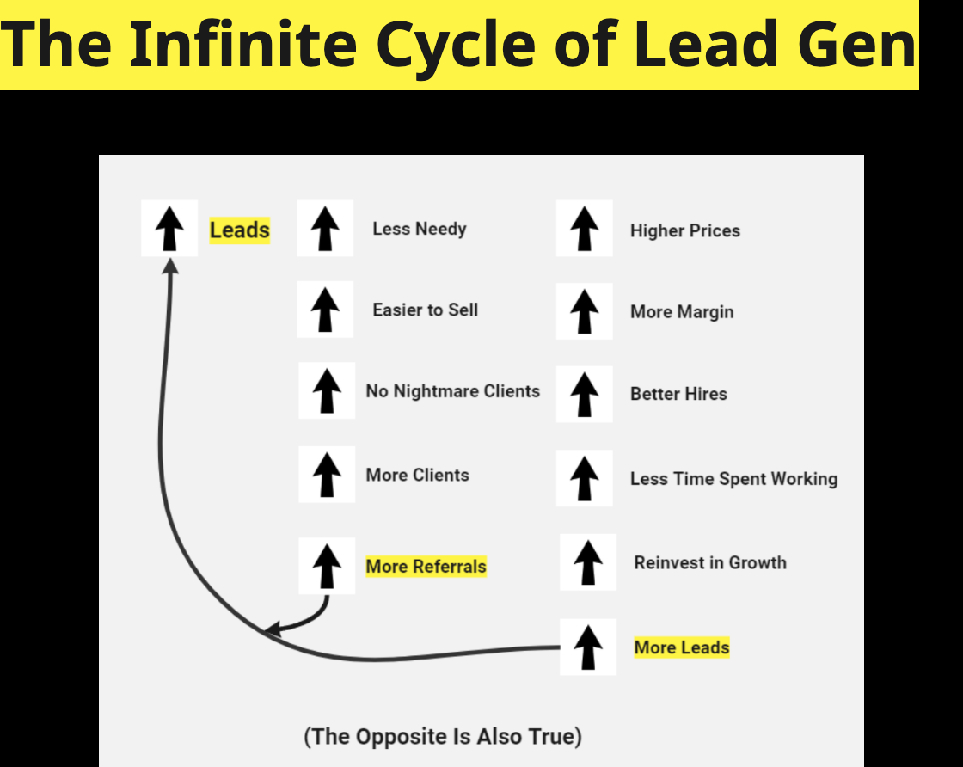
All service-businesses (anyone who sells to leads) are either on the “good” or the “bad” side of what I call “The Infinite Cycle of Lead Generation.”
This is a nasty little bugger for about 99% of businesses who are on the “bad” side of it (those who do not generate enough leads), but it is the most beautiful thing in the entire world for those who are on the “good” side of it.
The thing to realize is that this exists in the world as a matter of fact and reality. It does not exist simply because I made a cute little graphic for it. You are going to deal with this whether you join Lead Generation Academy or not, so you best understand how it works. It may explain a lot of your problems:
I love talking about Lead Generation because I think it is the most important part of a service-based business. I think this is true because almost every problem can be solved by generating more leads, and on the opposite side, almost every problem is caused by not having enough leads.
There is an invisible force in your business that you are either on the positive side of or on the negative side of and there is no neutral territory or “in-between.” I call this The Infinite Cycle of Lead Generation and let me explain a bit about how it works.
It is a cycle that goes over and over and over. When you are on the “right” side of it, it will create a positive flywheel that will make you scale bigger, better and faster than you ever thought possible. However, 99%+ of people are on the negative side of this and that is why they are stuck where they are. This is a fluid situation and just because you are on it once doesn’t mean you will be there permanently.
Here is how it works in one simple cycle:
And so on.
Assuming you continue to generate leads en masse, this loop will happen over and over and over and lead to exponential growth.
That is where you want to be, and that is where you can get with this marketing system.
However, 99%+ of people are on the opposite side, which is an ugly place to be.
Now here is a quick run through the bad side:
And so on. And on. And on.
The second position is where most people find themselves, and that is why this marketing system is so important. It is the best system on Earth to generate TONS of leads so you find yourself on the positive end instead of on the negative end.
Think of it.
Are you more likely to be on the “right” side of this when you have just a service-based agency or if you have a hybrid service-education agency?
Seems obvious to me.
And this is exactly why the system is built the way it is.
This is so effective because it builds leverage in your agency. How many times have you had negative thoughts about what you are working on or just agencies in general?
“Man, such low leverage.”
I’ve said that many times (although not once since I started this system), and I hear agency owners say it all the time.
Truthfully?
Yes, that is correct. A service-only agency has fairly low leverage.
But, when you have the full hybrid service-education ecosystem built around your agency, it becomes one of the highest-leverage models there is.
This marketing system builds leverage in your business.
For our purposes, we will define leverage as the difference between what you get out and what you put in. For example, if you put $1 in ad spend, and got $1 out, that would not be a very good form of leverage. If you put $1 in ad spend and got $10 out, that would be 10x leverage.
There are four forms of leverage in business. This comes from someone named Naval Ravikant.
They are:
Let’s go through these one at a time, and then talk a bit about how they may apply to a B2B service business in the context of this marketing system.
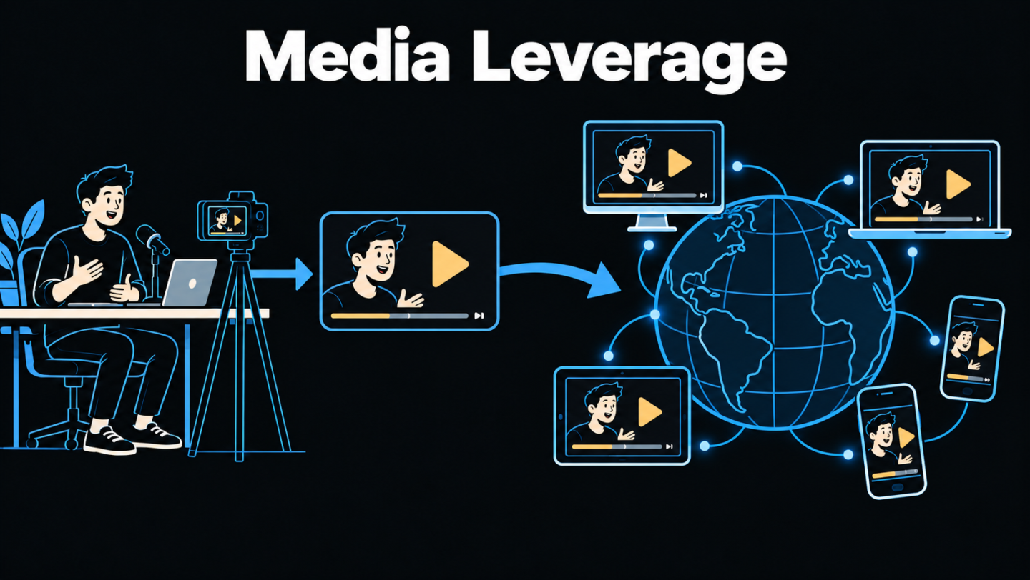
In regards to this system, you build media leverage by taking advantage of the fact that you only have to create something once, and then an untold number of people see it.
This applies to the following:
These all basically work the same, so let’s zero in on YouTube videos for the example.
If I record a YouTube video, I only have to do so once, and then 1,000, or 5,000 or 10,000 (or even more) people will see it.
This is leverage because I am getting out more than I am putting in. I only had to record it once and thousands of people will watch it.
It is not like I had to get on Zoom with all 5,000 people who watch it and explain the same video to them over and over, nor did I have to fly around the world and show them in person.
I am getting out more than I am putting in.
The thing to understand about leverage (all four types) is that it is a matter of yes and no (do you have it or do you not), but it is also a matter of how much. It is basically on a spectrum.
I (Matthew Larsen) have media leverage. I have a YouTube channel that about 15,000 people watch per month. Alex Hormozi has media leverage. Millions and millions of people watch his YouTube channel every month.
We both have media leverage, but he has much, much more media leverage than I do.
Media leverage is one of my favorites and seems to be one of the most valuable because it amplifies everything you do.
When you post content (media), it helps at every stage of the funnel:
It drives traffic at the top of funnel.
It helps capture, nurture and qualify leads in the middle of the funnel.
It converts people at the bottom of the funnel.
It even helps after you make the sale because your customers watch your content and become more bought in and less likely to churn.
Media (content) is one of the highest leverage things you can do in your business for all of these reasons and more.
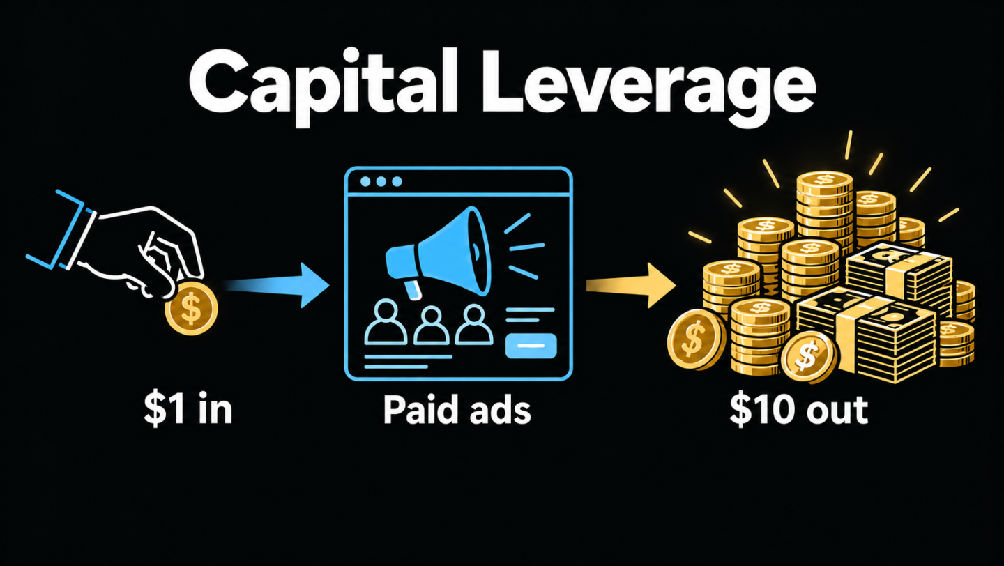
In regards to this system, you primarily utilize capital leverage through paid ads. In the simplest terms, if you put in $1 and get out $2, that is a form of leverage. You are getting out more than you put in.
Having huge success with paid ads is the closest thing to a realistic “money glitch” that you can get.
Of course, this is also a spectrum. Putting in $1 and getting out $2 is capital leverage. Putting in $1 and getting out $10 is MORE capital leverage.
The better your ads perform, the more capital leverage you have. In the context of this system, it is truly an “exponential” form of leverage, because once your ads are working, you can really 100x your ad spend. It is much harder to get 100x the results with content or labor (although it is possible, from a certain point of view, with code leverage, which I will talk about later).
You will also have tremendous capital leverage on the education side of things. Now that you have something to offer those who are not a good fit for your service, you will be making more sales and more profit than ever before.
If we take our service-based revenue as a baseline of 1x. Now, with our courses, consulting and products, we may go to 2x. In this case, we are getting out 2x more than we put in for very little or no additional time or work.
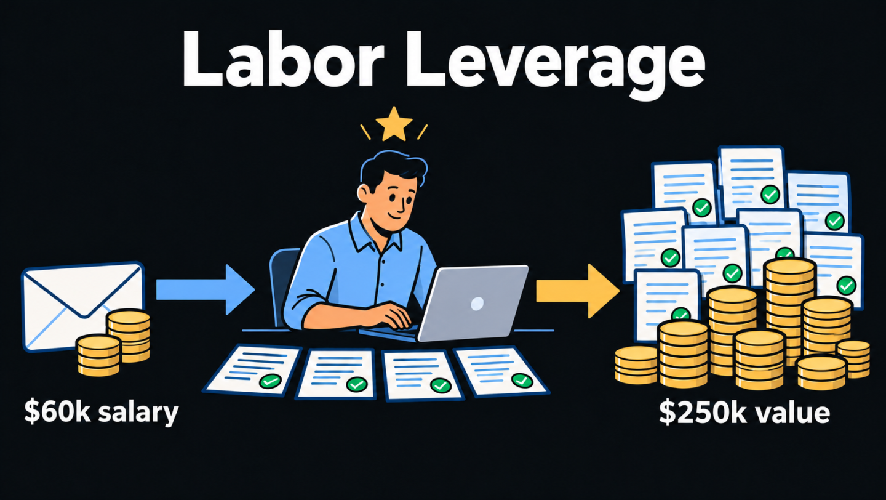
In regards to this system, we have a couple possibilities for labor leverage. In simplest terms, labor leverage is the difference in value between what you pay someone in salary (labor) and what you receive in work.
Labor and hiring is a form of leverage in and of itself as you now have more people working on the business, which means more inputs. This is especially true if (which should always be the case) you hire people to free up your own time which you can use to build more leverage.
There are two ways to get labor leverage:
Both are technically forms of labor leverage as you are getting out more than you put in.
For example, if you pay someone $60,000 per year and get $250,000 of value, that is labor leverage. You are getting out more than you put in.
This is why A Players are so sought after. They have the biggest “delta” between what you pay them, and what you get out of them.
On the other hand, if you used to pay someone $60,000 to get $100,000 of value, and now you can off-shore it and pay someone $30,000 to get the same $100,000 of value, that is a perfectly legitimate thing to do as well.
Both are labor leverage, and both are a spectrum. If you have 100 A Players, that is higher leverage than 10 A Players, or 1 A Player, and so on.
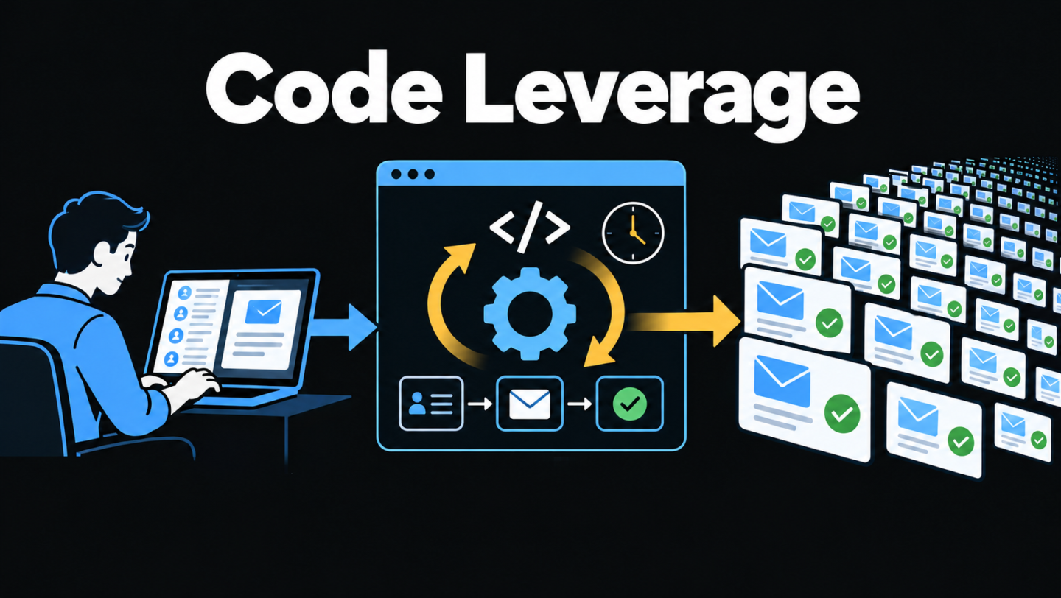
Code leverage is the use of software and automated systems to multiply human effort, allowing a small initial investment of work to generate massive, infinitely scalable output with zero marginal reproduction cost.
It is leverage because you basically set something up once with code (software, AI, automations and so on) and it will just work automatically without any (or very little) further oversight.
This is leverage because you are getting out more than you put in.
You set up the software, or AI workflow or automation once, and then it runs hundreds or thousands or tens of thousands of times, and this reduces your labor cost, and if you do it right, it should be better, faster, and cheaper than having humans do it.
Like everything else, this is also a spectrum. Facebook and Google have trillions of dollars worth of code leverage, whereas I use mostly basic automations to save time.
Consider the fact that before the calculator was invented, there were tens of thousands of people whose job it was to do the math and be “human calculators” so to speak.
Code leverage is one of the best forms of leverage because it is insanely scalable. It can and should be used to improve your fulfillment workflows as much as possible, as well as your client acquisition.
Consider the fact that even a few years ago, you would spend hours copying and pasting something like cold emails to tens of thousands of people if you wanted to do outreach. Now, you upload it to a software (code) like Instantly, and it does it all automatically for you after you set it up.
So that is the theory. Now let's talk about what it actually takes from you.
On a high-level, Lead Generation Academy works much like any coaching program or mastermind would work.
It combines:
Boy, I bet you haven’t heard that one before. Your mind is probably blown.
But on a tactical-level, you will find that it is far superior to anything you have been a part of up to this point. Of course, there is no way for you to know that until you join, and therefore, you may think this is just an empty boast, so let me lay out why I believe this to be true in an excessive amount of detail.
These three pillars determine whether you fail, succeed, or where you land on that spectrum. Everything we do in Lead Generation Academy falls under one of them.
This is you as the entrepreneur. Your beliefs, character traits, skills, habits, focus, work ethic and consistency. Your mind, your body, your heart and your soul.
Right now, you are the 1.0 version of you. If the 1.0 version of you could hit your goals, you would have already done it. So we need to build the 2.0 version of you, the person who can build this system, run it, and build a team around it.
This is the business you are asking people to buy from. We work on what I call the Core Seven:
A lot of lead generation stuff only talks about offers, but your offer is just one of the seven. You could build a funnel that brings in plenty of people, but if the offer does not make sense to them, you will struggle to sell. And if you do sell but it costs too much to deliver, more sales just means more work without leaving you much money.
This is how people find you, learn about what you do, and become clients. For a book a call funnel, we break it into four phases:
If any of these four phases fall apart, you don’t get the client.
I really like something called the Theory of Constraints. The weakest part of a system becomes the bottleneck for the entire system.
So if you have a 10 out of 10 business and a 10 out of 10 funnel, but you are a 2 out of 10 person, the entire business outputs as a 2 out of 10.
I have worked with about 1,800 businesses. If I had to guess, 97% of the time the number one constraint was the owner. 2.9% of the time it was their business. 0.1% of the time it was their funnel.
It might sound strange coming from something called Lead Generation Academy, but the person generating the leads and building the team to generate the leads is you. If you are not good enough to handle it, we are not going to generate a shitload of leads, are we?
This is the traditional course-style content. I have intentionally left out as many long videos as possible, and simplified down everything as step by step as I possibly can.
There are three group calls per week. These are more like high-level exclusive content calls, not just random, pathetic Q&A calls that no one wants to go to.
In keeping with the theme of the Three Pillars of Lead Generation Academy, the call topics are grouped into those high level categories, and I will include some example topics for each:
So many “masterminds” and coaching programs turn out to be pretty bad, and the community is the only value. While that is not the case here, we do community pretty well:
We are based on Skool and Telegram. Skool is the main course and asset platform. Telegram is the main chat.
I am extremely active in this. I sit at my computer 12-16 hours per day, six days per week for my main agency anyways, and I respond to questions as they come in.
While this is hard to quantify, I pulled the numbers and in the last 14 days, I have averaged over 115 Telegram messages per day, so if you think 115 messages is active and likely to provide good feedback, then there you go.
Once per quarter, we will be hosting an in-person event. The first one (transparently) is scheduled for March 2027. Q1, Q2 and Q4 will be in Dubai. Q3 will be determined (as Dubai is too hot in the summer).
Here is the tentative plan.
Each event runs for three days (Friday, Saturday and half of Sunday). There is no extra payment, because it is included in your Skool membership. You just have to get yourself there and book a hotel (we will get discounted ones).
On Friday, we meet in the Hilton Hotel Boardroom. We start with 12 five-minute rounds of speed networking in groups of three, so everyone meets everyone (or is one or two connections away), which makes the following two days better. Then we cover the Personal pillar.
On Saturday, we are back in the Hilton Hotel Boardroom for an early start, covering Business and Marketing, followed by a padel tournament and dinner at a steakhouse.
On Sunday, after another early start in the Hilton Hotel Boardroom, we build your 90 Day Plan for the time between now and the next event, then finish with a yacht day and party.
Every week, members get matched with other members for accountability and partnerships. You get a one-on-one intro with someone similar to you, so you always have people to check in with, share what is working, and build deals with.
It is optional, and you opt in during onboarding. Most of the best relationships in the group start here.
Transparently, this is still in development but we are beta testing it with our current community members and the results have been good so far.
This will specifically be trained on the concept of starting a hybrid service-education business, and all of the things that go beneath that such as offers, paid ads, content, outreach, partnerships, funnels, sales, email flows and more.
This will take better shape over time and will become one of the most valuable parts of Lead Generation Academy, but it is just not there yet, and I don’t want to mislead you.
Here is what the first 180 days would look like if you joined:
Let’s go over exactly what will happen once you click and pay on Skool.
Week 1 is the most important week. Here is exactly what you should do on day one, in this order:
Then, for the rest of Week 1:
By the end of Week 1, you should be done with the Personal System and ready to start building the full system.
Now we start building the funnel.
By the end of your first month, your full funnel should be built and connected from start to finish.
Month 2 is about building the four ways to get attention that feed your funnel, starting with content.
We start content first on purpose. When someone sees your ad later, clicks on your profile and sees a bunch of content, they are much more likely to book a call than if your profile was blank.
By the end of Month 3, your entire system should be set up, and you should already have a real body of content out on the internet.
Now you turn on paid ads, with your face and your content already out there.
This is a fast pace, and it is on purpose. Of the roughly 1,800 people who have gone through my courses, the ones who implemented the entire system are the ones who changed their business. This timeline is how you become one of them.
This currently costs $999/mo and you can cancel any time. There is a planned price increase once we have 150 unique paying members.
If you have a business partner, I will add them to the Skool as well (limited to one partner). They must have the same business email as you and you must prove they are your partner and not your random friend who is trying to get in for free.
Seeing how there are no sales calls, we also offer a seven-day guarantee. If you join, you can ask for a refund for any reason at all (you don’t even have to specify) for the first seven days, and we will give it to you.
During these seven days, here is what you can and should evaluate:
So the best case scenario is that you actually implement this, end up on the “right” side of The Infinite Cycle of Lead Generation, and your business starts to feel like a completely different reality from the one you are in now.
To show you how big of a difference this makes, let’s say you want to make $1M per year in net profit:
That is just math. Same goal, completely different business. Building the second type of business is what we are here to do.
I know that much of the due diligence process is “how badly could I get fucked if I join this?”
Realistically, if you joined and thought it was SO bad that it was an insult to you and your time (and you did not ask for a refund in the first 7 days under our guarantee), the worst thing that could happen is that you lose $999, which is one month.
You are not locked in like all these other things where you are making a decision for $12k, $30k, $100k+ up front. It is basically a $999 decision for you.
I would say that this is a very, very good “asymmetrical bet” on your part. You are risking $999 for a potential business and life-altering improvement.
Considering the fact that you’ve probably bought things many times more expensive than this with far less guarantees and far more risk, I don’t think this should stop you.
No. This is a direct-to-checkout offer. You join on Skool and you are in. That is why this page goes into so much detail, and why there is a seven-day guarantee.
Yes. For the first seven days, you can ask for a refund for any reason at all (you don’t even have to specify), and we will give it to you.
Skool and Telegram. Skool is the main course and asset platform, and about 90% of everything (courses, community, calls) lives there. Telegram is the main real-time chat.
Yes. Everything happens online through Skool and Telegram, and all three weekly calls are recorded and added to Skool, so the time zone does not matter.
Over 90% of the members are agency owners. But whenever I say agencies, you could just as easily substitute any online service-based business and everything would apply just the same.
Mostly just software, and only if you don’t already have it. Things like an email sending platform (Kit or Beehiiv), website hosting, or Webflow, which is where our website templates are hosted. Other than that, there are no additional costs. For the IRL events, you just have to pay for your own flights and hotel (we will get discounted hotels). Everything else at the events is paid for.
As long as it is worth it to you. You are not locked in and you can cancel any time in your Skool account. I want this to be something you can stay in forever, both in terms of affordability and in terms of value. If you don’t think it is worth it, I expect you to leave (and I would appreciate a DM telling me why, so I can make it better).
Four hours of time-blocked deep work per day: two hours on building your course and two hours on building the ecosystem and funnel. On top of that, there are three one-hour group calls per week, and all three are recorded and added to Skool if you can’t make them live.
Probably. Over 90% of the members are agency owners, and the group is best for people doing between $500k and $10M per year.
Once per quarter, we host an in-person event over three days (Friday, Saturday and half of Sunday). Q1, Q2 and Q4 will be in Dubai, and Q3 is still to be determined. The events are included in your membership with no extra payment. You just have to get yourself there and get a hotel (we will get discounted ones).
Yes. All three weekly group calls are with me. I sit at my computer 12-16 hours per day, six days per week, and over the last 14 days I have averaged over 115 Telegram messages per day. You can send me your ads, your funnel and your content for feedback.
No. The price is set the way it is (low, comparatively) to reflect that there are no sales calls or one-on-one calls. When I do the one-on-one version, it starts at $100k per year.
No. There are no discounts to join Lead Generation Academy.
Yes, limited to one partner. They must have the same business email as you, and you must prove they are your partner and not your random friend who is trying to get in for free.
Yes, as long as you stay. If you leave and come back, you will pay whatever the new price is, with no exceptions. The price will go up over time, starting with the planned increase once we have 150 unique paying members.
It is open to anyone, but you should already have a business and customers. You also need to be willing to change things and do the work as you go: build what the modules show you, bring it into the group for feedback, and make changes based on the results. If you want a different result while keeping everything exactly the same, this will be very frustrating for you.
Technically, nothing stops you. But this is not for beginners and it is not a biz-op. It will not teach you anything from scratch, and if you join below $500k per year, you will not be babied or treated differently.
Yes. The group is best for people doing between $500k and $10M per year, so the more established you are, the more you will get out of it. I am a partner in a pay per lead agency that only works with clients paying $50k/mo or more, and I still run this same system myself. If you are advanced, you will probably move through the setup faster and spend more of your time on scaling.
Each week you get matched one-on-one with another member who is similar to you, for accountability and partnerships. It is optional, and you can opt in during onboarding.
You have two options.
You can keep running your agency the way you are now. Same feast and famine, same hamster wheel, same Stripe number as last year. That is a real option, and plenty of people take it.
Or you can build the hybrid service-education ecosystem around the agency you already have, put in your four hours a day, and work on getting to the right side of The Infinite Cycle of Lead Generation.
It is $999/mo, you can cancel any time, and you have seven days to ask for a refund for any reason at all. The worst case is one month. The best case is a completely different business.
If that makes sense to you, I will see you inside.